
Where is your medicine cabinet?
If you’re like a lot of people I know, it’s probably in the bathroom. Maybe you even have one of those mirrors that opens up with shelves conveniently hidden behind it.
It seems like the obvious place to keep medications. After all, we call it a medicine cabinet.
But depending on your bathroom, it may actually be one of the worst places in your house to store them.
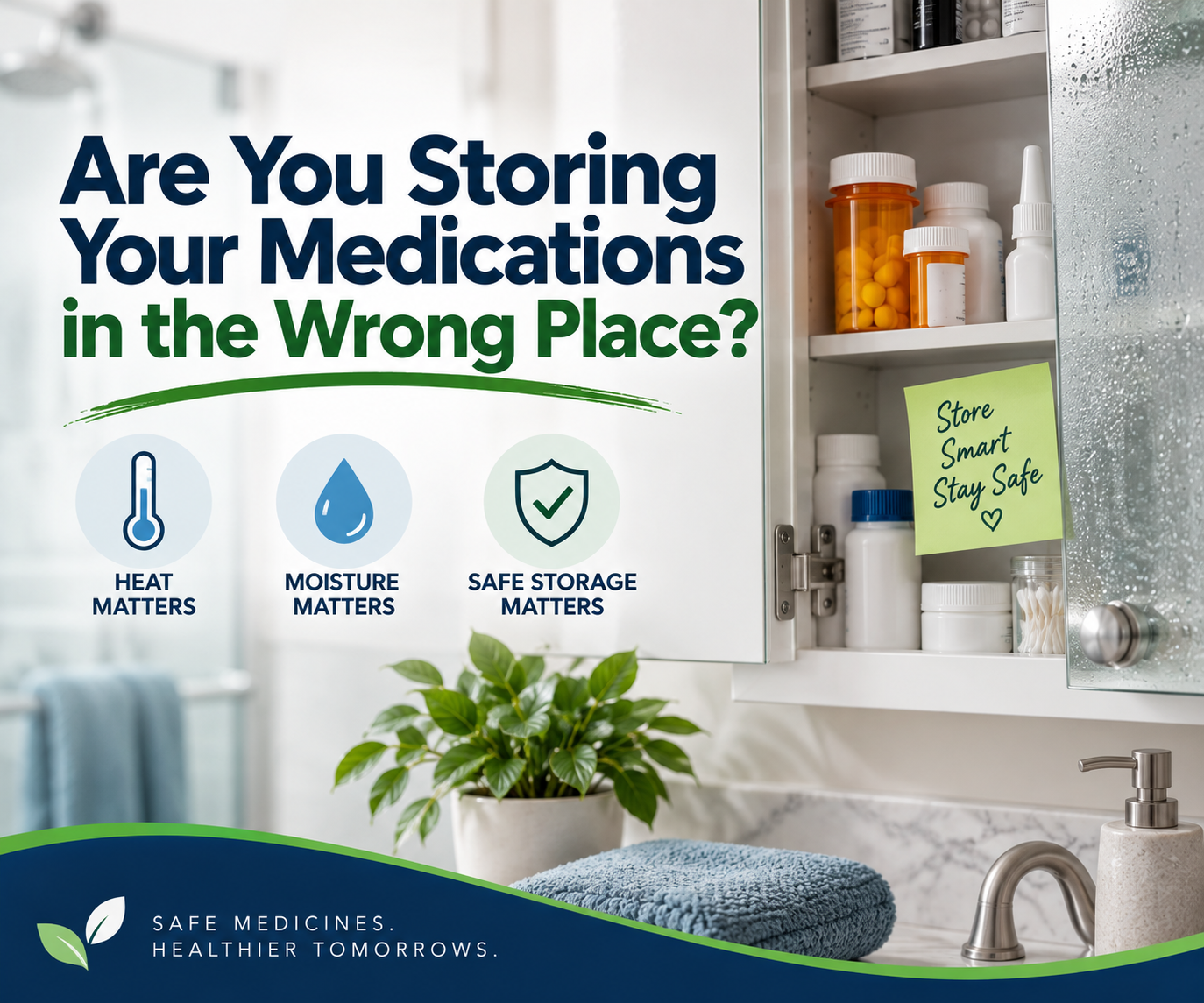
Why the Bathroom Can Be a Problem
Think about what happens every time someone takes a hot shower. The room gets warm, the mirror fogs up, and humidity rises.
That may be comfortable for you, but it isn’t necessarily ideal for your medications.
Heat, humidity, and moisture can affect the stability or quality of some medications over time. That’s why many medications are labeled to be stored in a cool, dry place.
Now, if your medicine cabinet is in a guest bathroom where nobody showers and the room doesn’t regularly become hot or humid, that’s a different situation. The concern may be much smaller.
The most important rule is simple: always follow the storage instructions on your medication label.
So, Where Should You Keep Your Medications?
Here’s where the answer gets a little less straightforward.
There isn’t one perfect location that works for everyone or every medication.
You need to consider the medication’s storage requirements, who lives in your home, and what will help you remember to take it correctly.
In general, look for a location that is:
- Cool and dry
- Away from direct sunlight
- Away from excessive heat and moisture
- Secure from children and pets
- Convenient enough to support your medication routine
That last one matters too. A perfectly safe storage location doesn’t help much if it’s somewhere that causes you to regularly forget your medication.
Use Your Daily Routine to Your Advantage
Maybe you take your morning medications with breakfast every day. Keeping them in a dry, secure kitchen cabinet away from the stove, sink, dishwasher, and other sources of heat or moisture may help connect taking your medicine with your morning routine.
If you take medication at bedtime, keeping it somewhere associated with your nighttime routine may help you remember it.
However, convenience should never come before safety.
A pill bottle sitting beside the coffee maker or on your nightstand may be a great reminder for you, but it can also become easily accessible to a child, pet, visitor, or someone else who shouldn’t have access to it.
The goal is to find a location that helps you remember your medication while still keeping it secure.
Keep Medications Up and Away
If you have children in the home, or children who regularly visit, medications should be kept up, away, and out of sight.
And remember: child-resistant doesn’t mean childproof.
Pets are another consideration. A bottle left on a low counter, bedside table, or in an open bag can quickly become accessible to a curious dog or cat.
Controlled substances and other medications with the potential for misuse deserve additional attention. Keeping these medications secure and out of sight is important. Depending on your household, a locked medication box or cabinet may be a good option.
What About Refrigerated Medications?
Some medications have very specific storage requirements and need to be refrigerated.
If yours does, follow the instructions carefully.
But don’t assume colder is always better. Some refrigerated medications should never be frozen, and certain products may have different storage requirements after they’re opened or removed from refrigeration.
What happens if you accidentally leave a refrigerated medication sitting on the counter?
Don’t automatically throw it away.
Give us a call at Cornwell Pharmacy. Depending on the medication, temperature, and amount of time it was left out, we may be able to help determine whether it’s still okay to use.
Pill Organizers Can Help, But Ask First
A weekly medication planner or pill organizer can be a great way to keep your medications organized and make your routine easier to follow.
However, not every medication is appropriate to remove from its original packaging.
Some medications have special storage requirements or need protection from things like moisture or light.
If you’re thinking about moving your medications into an organizer and aren’t sure whether it’s appropriate, ask your pharmacist.
And Don’t Forget About Your Car
Here in Oklahoma, this is a big one.
Don’t routinely leave your medications in your vehicle.
A parked car can become extremely hot, especially during the summer, and those temperatures may be well outside the recommended storage conditions for your medication. Extreme cold can also be a concern for certain products.
If you’ve accidentally left a medication in your vehicle during extreme heat or cold, call us before assuming it’s ruined or assuming it’s fine. We can help you determine what to do next.
So, What’s the Best Place?
There isn’t one answer that works for every person or every medication.
For most medications, you’re looking for a location that’s cool, dry, secure, and convenient enough to support your daily routine, while always following any specific storage instructions provided with the medication.
Maybe that’s a secure kitchen cabinet. Maybe it’s a locked medication box. Maybe one medication belongs in the refrigerator while the rest are stored somewhere else.
Your medications don’t all have to live in the same place.
If you’re unsure whether your bathroom cabinet, kitchen cabinet, refrigerator, pill organizer, or another location is appropriate, give us a call or stop by Cornwell Pharmacy. We’re happy to help you figure out the best way to store your specific medications.
Because medication safety isn’t just about taking the right medicine at the right time.
It’s also about taking care of it properly between doses.
This article is for general educational purposes and is not a substitute for individualized medical advice. Always follow the storage instructions provided with your medication and contact your pharmacist or healthcare provider with questions about proper medication storage.
